
Frankfurter Küche 100 Years of Kitchens
The Invention of the Frankfurt Kitchen – A Milestone in Architectural History
In 1926, Ernst May brought a woman from Austria to Frankfurt who designed the first standardized built-in kitchen and thus made architectural history: Margarete Schütte-Lihotzky, Austria’s first female architect with a degree, analyzed movement patterns, hand movements, and work processes in the kitchen and used this to develop an architectural design whose ergonomic and functional layout remains exemplary to this day.
The architect’s goal was to enable the most efficient and pleasant working conditions possible within a few square meters—an approach that defined an era. The Frankfurt Kitchen is considered the archetype of the modern built-in kitchen because it was the first to be planned as a unified and standardized workspace: functional, space-saving, and geared toward efficiency and industrial mass production. A kitchen that continues to inspire us today, as our Limited Edition demonstrates.
The "Frankfurt Kitchen" was the attraction at the Frankfurt Spring Fair in 1927. More than ten thousand kitchens of this type were installed in various variants in the Frankfurt housing estates, which were built by city planning officer Ernst May in order to provide broad sections of the population with inexpensive, functionally equipped apartments.
The "Frankfurt kitchen" became famous because it almost paradigmatically embodied the guiding concepts of functionality and standardization, as they shaped the architecture and product culture of the 1920s and, in a somewhat different form, even in the 1950s and 1960s.
Frankfurt Kitchen Design: When Details Take Center Stage
From the length and width of the room to a wide range of details, every aspect of the Frankfurt kitchen has been carefully thought out down to the smallest detail. Here are a few examples:
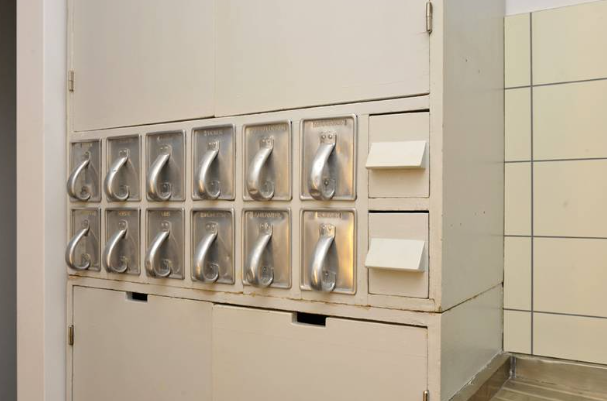
The distinctive pull-out bins provide quick access to everyday food items.
Under-cabinet handles are not only sturdy and durable, but also easy to open, ergonomically designed, and easy to keep clean.
The floor-to-ceiling design makes every square inch of the limited living space usable and creates ample storage.
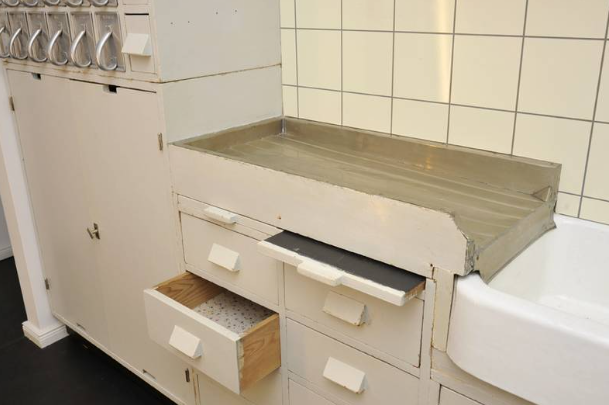
Pull-out shelves instantly expand the countertop space and can be slid back in at any time—whenever needed.
An integrated aluminum drainboard provides the space needed for washing dishes and stands out for its hygienic, rust-free quality.
The built-in cupboards are set on a recessed plinth, so that you could get close to the work surfaces.
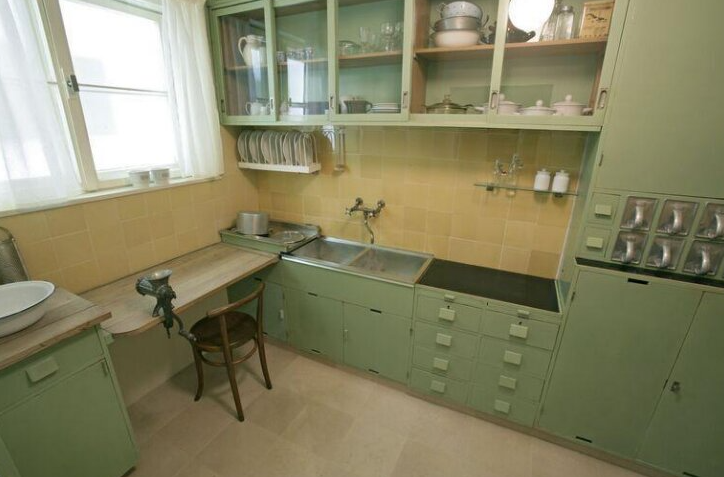
On the shelf next to the sink, the dishes were simply drained instead of drying them as before. On the pull-out, linoleum-coated plate underneath, you could cut bread or put down pots.
The guiding principle in the planning of the kitchen was freedom of movement. Numerous elements can be pulled out or folded down when needed and disappear from the field of view and movement when not in use. The robust worktop - placed in front of the window because of the light - can be folded up, and a swivel stool stood underneath it. Before that, you could also fold down an ironing board to effectively fill the work breaks - for example when the soup was boiling. Above the drawers next to the sink, storage and cutting boards with linoleum coating can be pulled out. In this kitchen, there were no more table and chair legs to bump into. The built-in cupboards are also set on a recessed plinth, so that you could get close to the work surfaces. The glazed wall cabinets do not have doors that stand in front of the face of the person who opens the door, but can be slid open.
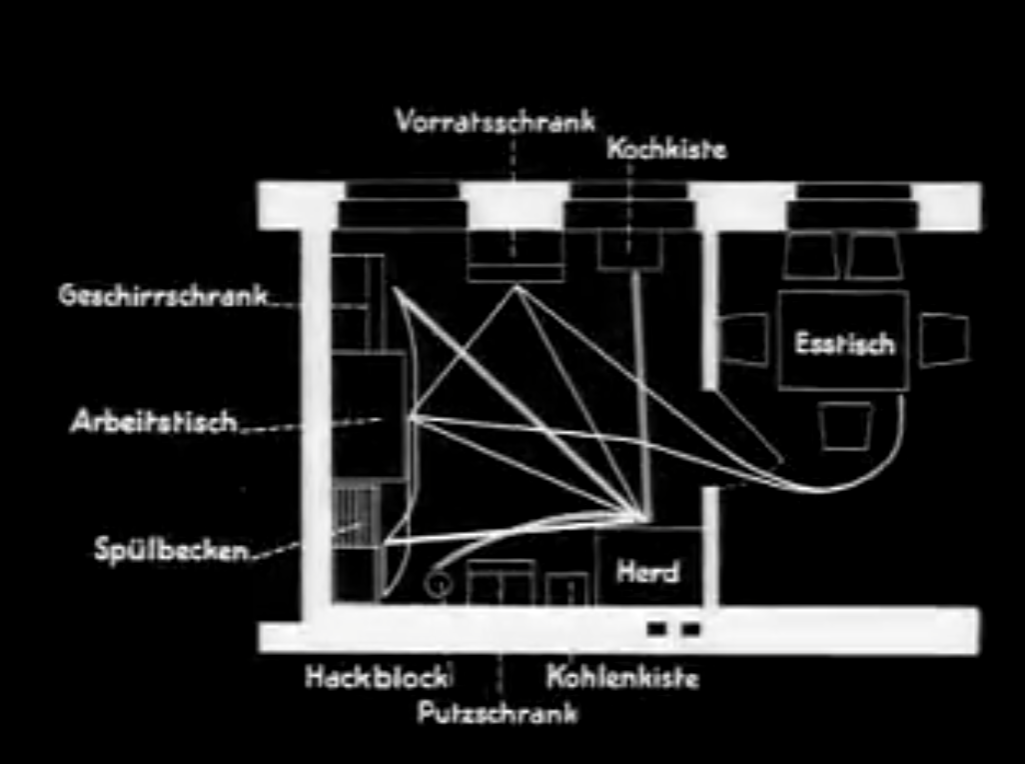
Workflow in a pre-1926 Kitchen
Choosing wood with foresight
Like every detail of the Frankfurt Kitchen, the choice of wood was not merely an aesthetic consideration for Margarete Schütte-Lihotzky, as evidenced by the storage bins. Since the containers are not airtight, they are vulnerable to infestations by pests or the growth of mold. The design of the Frankfurt kitchen demonstrates foresight in its choice of materials—specifically, the use of oak and pine. The pungent scent of oak repels insects, while pine, due to its hydrophobic properties, helps prevent mold and fungal growth.
Frankfurt after World War I
Like many major German cities, post-war Frankfurt was marked by a severe housing shortage due to war damage and years of neglected housing construction. The response to this was a housing and urban development program initiated in 1925 and led by City Planning Director Ernst May, designed to create affordable housing in a short period of time: functionally designed, cost-effective to build, and tailored to people’s needs.
Although the Frankfurt kitchen was installed in a large number of Frankfurt homes, only a few examples remain today. Over the years, it has become a sought-after exhibit. Today, only one restored example remains in its original location: it can be seen in the Ernst May House.
The images shown on this page depict a reconstructed Frankfurt kitchen from the design collection of the Ostwestfalen-Lippe University of Applied Sciences and the Lippisches Landesmuseum Detmold, which now has a permanent home on the Detmold campus. It was installed in 1928 in a three-bedroom single-family row house in the Frankfurt housing development “Römerstadt” and remained in use until 1995. It was subsequently removed during a home renovation and reconstructed twenty years later by the Detmold School of Design under the direction of Prof. Dr. phil. Andreas K. Vetter.
Margarete Schütte-Lihotzky
The aluminum chutes are labeled with lentils, peas, semolina, sugar, oatmeal, macaroni, etc.
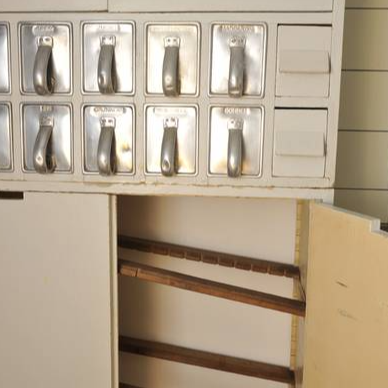
Pots, dishes and food supplies are arranged on top of each other to save space, semolina, rice and lentils are stored in pull-out aluminium chutes: this is faster than having to take glasses off the shelf and screw them on.
The top rods in the pot cabinet have grooves for the pot lids.
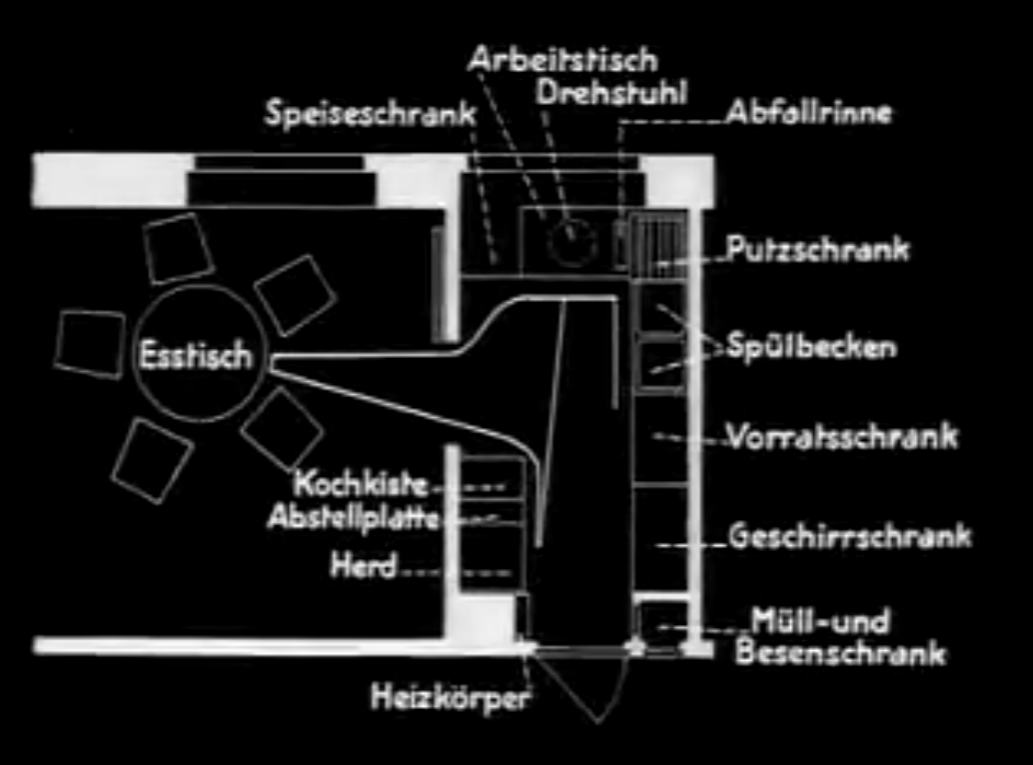
Workflow in a post-1926 Frankfurt Kitchen
Additional exhibits from the Frankfurt Kitchen can be found at the following locations: